 Heavy lift · Kerbin · Era 9
Era 9 · Ascendant · Interplanetary-scale
To orbit. To station. To the Mun. To Duna.
KerbalX builds the vehicles that lift the programme. SOLARCOM relays in solar orbit. The LLS family that landed on the Mun, refueled in lunar orbit, and rescued six crew. BelugaX: the heaviest lift ever attempted, now cleared for production. HESTIA's main stack - 17 of our most powerful engines. We own the lunar logistics chain. Now we're building the Duna-lift chain. Nine eras. Zero crew lost on our vehicles. Still.
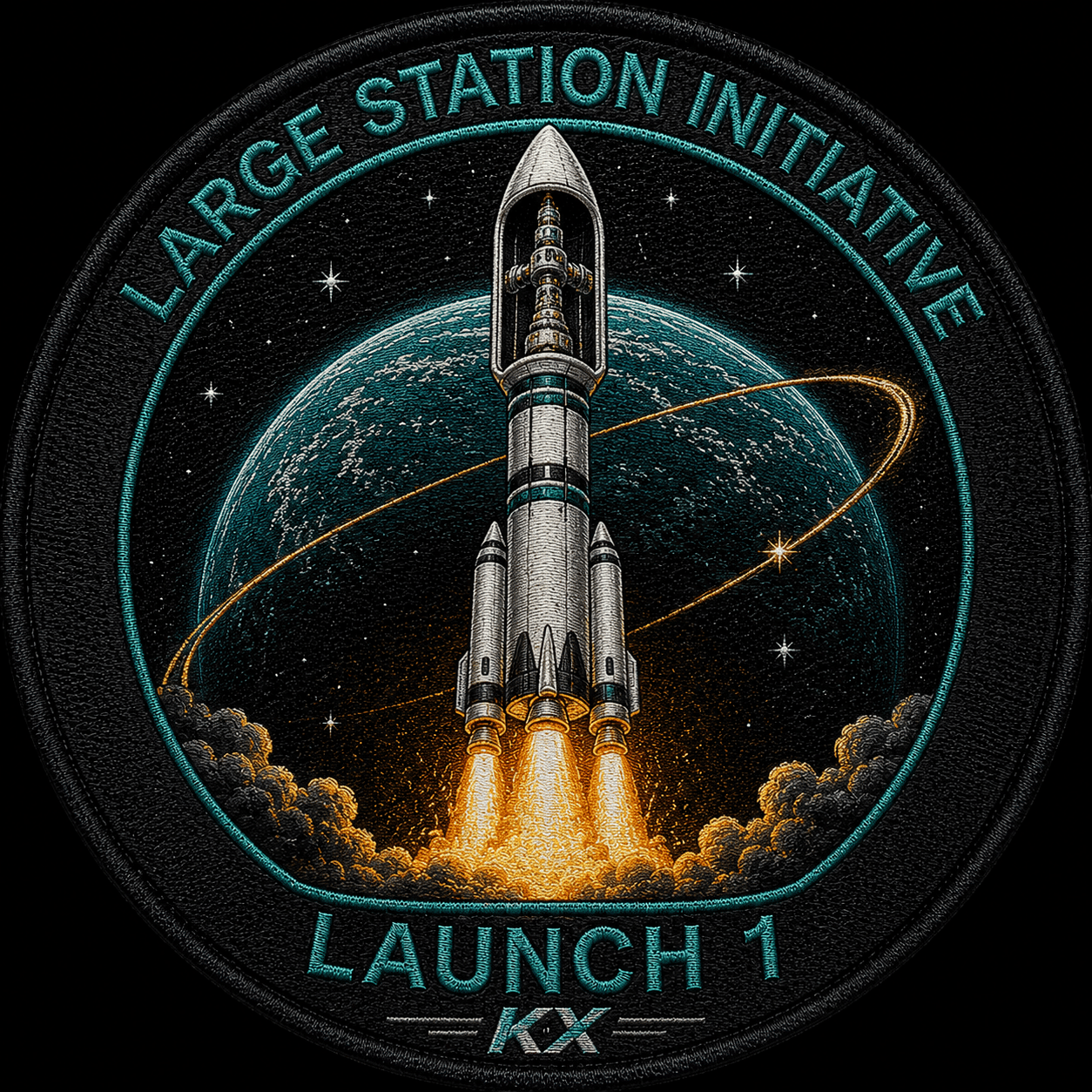
Heavy lift · Era 9 debut
BelugaX - the heaviest lift ever attempted
Two stages · Second stage reusable
BelugaX heavy-lift class
The heaviest, most powerful payload delivery vehicle the programme has attempted. Two stages: first stage expendable, second stage fully reusable. Payload bay three times OTS capacity. Beluga-whale nose silhouette. TWR 4.17 at liftoff. Explicit Duna-lift and Duna-lander ambitions. Four flights. Three failures. Then METEOR: OMS deorbit to preserve main-engine fuel for terminal deceleration. HESTIA's crew watched her come down as a bright light passing beneath them. Val's radio call named the patch. Hovered above the ocean, set down for recovery. Production version under construction.
HANDOFF: stage separation failure, engine caught in decoupler. CASCADE: engine cascade failure on reentry, imploded mid-descent. AEGIS: inflatable heatshield worked, but on decouple the shield caught on an engine and ripped away. METEOR: full success. OMS deorbit, main-engine terminal deceleration, ocean recovery. KerbalX cleared to build production version.
LLS family · Lunar Landing Systems
Six vehicles. One family. We own the lunar logistics chain.
Pioneered by KerbalX with input from every contractor in the programme. The KeedMartin LLS Third Stage is the common ancestor - carried unchanged into the LLSX and LRS. We built the launch architecture, the refueler, the orbital systems. KOEING built the upper stage and lander. The result: a family of vehicles that lands on the Mun, refuels in lunar orbit, and runs the surface from above.
LLS-2 stranded crew beyond Kerbin orbit. We built LRS in response. LLSX-2 ran out of monopropellant mid-docking and collided with LRS. Melody remotely flew the LRS itself to complete the dock - first lunar-orbit docking and refueling in history. Every routine Mun mission runs on our hardware. Every Duna candidate trains on our vehicles.
Lineage table
HESTIA · Tri-party · Era 9
We built Unity's main stack. Seventeen engines.
Unity was the most ambitious shuttle build attempted. Four contractors: NASA integration, KerbalX main stack, KeedMartin Skunkworks air-breathing afterburners, KOEING SRBs. We built the extended fuel tank and packed 17 of our most powerful rocket engines into it. OVERTURE ended in the largest explosion in programme history - main engines over-performed, SRBs added stack imbalance. Read as integration failure, not hardware failure. Unity rebuilt fast (REPRISE). Next Unity gets an integration test article first. That is on the record.
ORION Mk2 is our heavy payload delivery vehicle. Heavy lift for large payloads including the ORION Refueler and the Passage probes that confirmed and traversed the Juno wormhole. No recovery ambition. Reliable. Active. The ORION Refueler is still in LKO - its docking port was damaged, which blocked KOEING's ENCORE retrieval attempt. We built the fuel depot that the programme refuels from. The door is broken. We know.
SOLARCOM · Deep relay
Relays in solar orbit. The wormhole has a name now.
KerbalX won SOLARCOM against KOEING's LLS-2 bid. Both relays are on station in solar orbit. The wormhole designated Juno was confirmed by Passage 1 and traversed by Passage 2 - both launched on our ORION Mk2. Passage 2 is in another stellar system. The relay network that was built to communicate with Juno is now the programme's deep-space backbone. HESTIA's telemetry comes home through our hardware.
FARVIEW-1 - KeedMartin's deep-space probe, launched on FSOM+SLS2 - communicates exclusively through our relay network. Every image FARVIEW-1 has sent, including the one below, passed through SOLARCOM.
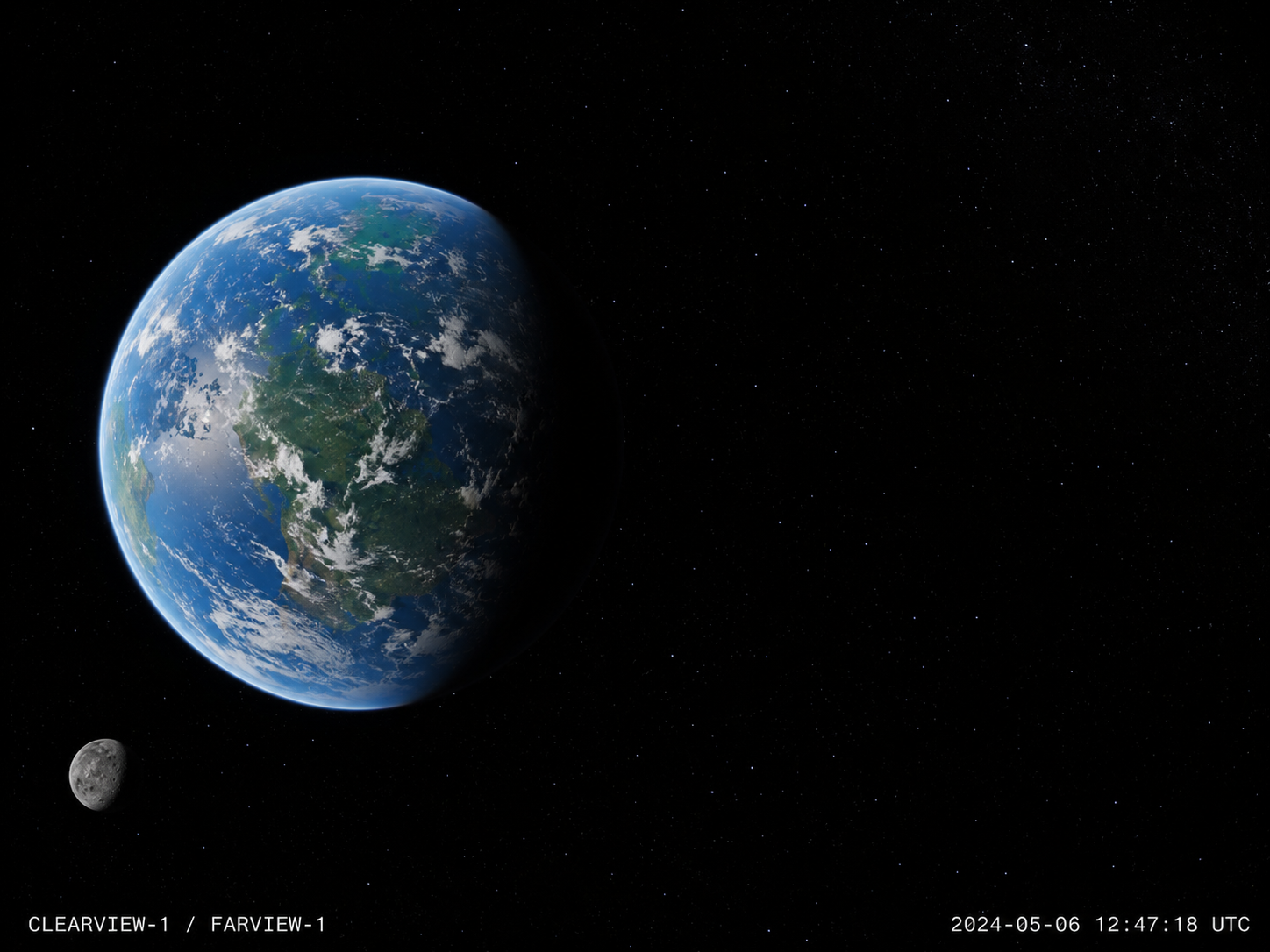
“The Farewell Shot” - CLEARVIEW-1 / FARVIEW-1. Transmitted to Kerbin via SOLARCOM. The anomalous point source it found was Juno. We carried the camera that found it.
LSI 1 · Retired with honors
First station. Correct ports. Decommissioned. We moved on.
SH-4 delivered the LSI 1 core. SH-4B delivered KeedMartin's RESTLESS habitation module. Five modules, all ports occupied, sustained station science. LSI 1 served through Eras 3-7. When cost outpaced science, the crew left on the attached SLS-2. Valentina flew an R-SLS2+ up to recover the rest. Deorbited into the ocean with full honors. We built it, we ran it, and when it was time, we let it go. LSI 2 is in lunar orbit now. We helped build that too.
Flight heritage · KerbalX · nine eras
- Era 1Starship 2C - first landable booster, ground control only. KerbalOrbit goes to KOEING. We learned humility and telemetry.Retired
- Era 2Starship Heavy 3 wins SOLARCOM. Both relays delivered. The network is live even if the press release is a shrug emoji.On orbit
- Era 3SH-4 launches LSI 1. MSC-003 docks. SH-4B delivers RESTLESS. Station expands to 5 modules. KOEING runs the taxi; we run the heavy lift.Operations
- Era 4ORION Mk2 heavy lift enters service. Passage 1 and 2 probes launched on our stack. One entered another stellar system. KX Mk2 booster reusability program: 3 tests, 3 fires, progress real.Active
- Era 5LLS enters testing. Tri-party: our launch architecture, KeedMartin third stage, KOEING upper stage. LLS-2 strands crew. We build LRS. Six crew rescued. Zero lost.Complete
- Era 8LLSX, LRS, LOS, LOSXL, LES all enter service. We own the lunar logistics chain. LSI 2 crew delivered on LOSXL. FOUNDATION base built with our remote-pilot capability.Operational
- Era 9BelugaX heavy-lift class debuts. 3 failures, then METEOR: full success, ocean recovery. Production version under construction. Duna heavy lift and heavy Duna lander both now on the table. We built Unity's main stack - 17 of our most powerful rocket engines. HESTIA is on her way.Production
Reusability program · ongoing
KX Mk2 Booster - learning to land
Test 1 and 2: spin-induced reentry overheating. Test 3: reentry solved via active center-of-mass fuel transfer, tips on landing. Three disassemblies, three distinct lessons. Test 4 pending. Zero recovered so far. The programme is patient. The booster is learning. We are not done.
Careers · internships · skepticism welcome
If you can close a fault tree while someone asks why the xenon plume looks like that on TV, you will fit in. We just landed a booster in the ocean, built the main stack for an interplanetary vehicle, and we're clearing BelugaX for Duna. Applications are fictional; ambition is not.
Return to Kerbal InternetWHAT IS NEXT
Duna or nothing.
We proved BelugaX can fly and land. The production version is under construction. The study is open: can a BelugaX-derived vehicle go to Duna itself? The answer is not theoretical. It is a matter of engineering, and we are engineering it.
We built the main stack for the first interplanetary vehicle. 17 of our engines pushed HESTIA to orbit. We built the lunar logistics chain that trained the crew. We built BelugaX, crashed it three times, and landed it in the ocean on the fourth try. The production version is the vehicle that changes what the programme can deliver to another planet.
Duna heavy lift. Heavy Duna lander. A base on another planet in a single payload. That is not a press release. That is a schedule. We are on it.