Kerbipedia
Snapshot: 7/22/2026, 11:16:27 AM (20260722T111627Z)
About KerbipediaAboutarticle
Kerbipedia is a free encyclopedia hosted on a single LSI module and edited by anyone with thumbs and access to a Snack Server. It currently contains 8,412 articles in Kerbali, 15,221 since the Greening, and approximately 1,800 articles authored or substantially edited by a user named Bob_Kerman_42, who is widely believed to in fact be Bob Kerman.
The encyclopedia is funded by occasional, mild fundraising drives. The fundraising banner is the small amber rectangle in the sidebar. We will not put an enormous picture of the founder at the top of every page. We have, in writing, promised this.
What Kerbipedia is not
- An accurate source of orbital mechanics. (Use OMQ.)
- A primary source. (Wait for the Herald.)
- Neutral on the Pothole Question. (We have tried. We have failed.)
What Kerbipedia is
- The single most-cited reference on the planet whose claims have been independently verified the second-fewest of any major reference work.
- The only place the canonical seven causes are stable across editions.
- The reason any particular kerbal can tell you, on demand, that the Council Chamber roof has been "due for repair" for one hundred and fifty years.
- The only encyclopedia with an article about a wormhole that the operator of the wormhole has not confirmed exists.
- the Kerbipedia Foundation, Year 419
Basic StationBasic_Stationarticle
Basic Station (also: Star Ship Station) was a small orbital outpost built by KerbalX as the first deployment of the Large Station Initiative. It is no longer in service.
During MSC-002, the crew of R-SLS2 attempted to dock with Basic Station and could not. The docking port had been built to a specification that did not match the standard KerbalX had submitted to NASA. Mission commander Valentina Kerman performed an unplanned EVA to manually deploy a stuck solar panel and verify the airlock interface, confirming the mismatch. The crew then re-boarded R-SLS2 and returned safely to Kerbin.
NASA decommissioned Basic Station shortly thereafter and directed KerbalX to build a replacement. The replacement, LSI 1, was launched with a corrected interface specification, verified prior to MSC-003.
The Basic Station incident is the most expensive single mistake in the MSC program to date. It is also the only mistake that has led to a published, program-wide spec re-verification standard. OMQ has used the phrase "a unit problem dressed as a vehicle problem" in three separate editorials.
Causes of death (kerbal)Causes_of_Deatharticle
Kerbals (q.v.) are indefinitely viable: in the absence of an external cause, a kerbal does not die. They do not develop cancer. They do not have heart attacks. They do not "go in their sleep." A kerbal who is left alone in a room with snacks and a window will, on present evidence, remain alive forever.
This is, on Kerbin, considered completely normal. The cultural framing is not "why don't we die" but "why do you." Visiting xenobiologists routinely report that asking a kerbal about natural causes of death is met with the same expression a kerbal would give if asked to describe the natural causes of Tuesday. There aren't any. Tuesday just happens. So does staying alive.
Kerbals do, however, die. Below is the canonical, Council-recognized list of causes of death in kerbalkind. There are seven. The list has not been amended since Year 318, when "Disagreement with the Mun" was added under unusual circumstances. The list was reviewed in Year 418 following the completion of six crewed Mun landings and the departure of HESTIA for Duna. The review concluded that no amendment was necessary. The Mun landings did not retroactively validate Murray Kerman's hypothesis. The Mun is not a hologram. It has been walked on.
The Seven Recognized Causes
| № | Cause | Definition | Annual rate (Y. 418) |
|---|---|---|---|
| 1 | Lithobraking id. terrain.impact | Unscheduled contact with a hard surface at a velocity greater than the kerbal in question can absorb. The most common cause of death in kerbals. Includes falls, vehicle accidents, dropped tools, and the entire history of recreational mountaineering. | ~14,800 / yr |
| 2 | Unplanned rapid combustion id. fire.event | Combustion at a rate the affected kerbal had not planned for. Includes industrial accidents, kitchen accidents, and the complete inventory of Starship 3C recovery attempts. | ~3,900 / yr |
| 3 | Vacuum exposure id. helmet.absent | Direct contact between a kerbal's biology and a vacuum. The vast majority of cases involve helmet failure. The remaining cases involve helmet absence and a series of decisions the deceased made between Tuesday and Wednesday. | ~140 / yr |
| 4 | Drowning id. water.lower | Cessation of respiration via submersion. Rare among kerbals, who can hold their breath for approximately twelve minutes and who float in saltwater. Almost all documented cases involve boating convictions - a kerbal who is sufficiently certain that the boat will not sink. | ~62 / yr |
| 5 | Snack famine id. snack.absent | Caloric absence beyond the photosynthetic floor (~9 days). The last documented mass case occurred prior to the Greening. Modern incidence is approximately zero, except in the Dricken Valley incident of Y. 408, which was eight kerbals who refused to eat a particular brand of snack on principle. | ~8 / yr |
| 6 | Disagreement with the Mun id. mun.dispute | One (1) recorded case. The deceased, identified as Murray Kerman, repeatedly stated, in writing, that the Mun was a hologram. Cause of death is officially listed as "fall from cliff while pointing at sky." The Council has retained the entry under "out of an abundance of caution." The Mun has since been walked on by six kerbals. It is not a hologram. | 0 / decade |
| 7 | Volunteer status id. consent.signed | A procedural cause. Refers to deaths occurring during activities for which the deceased had filed a volunteer form in advance - most commonly test pilot work, recreational demolition, and the entire profession of mountaineer. Volunteer status does not change the actual mechanism of death; it changes the paperwork. | ~110 / yr |
There is no eighth cause. The Council has rejected proposals to add an eighth cause on twenty-three separate occasions, most recently in Year 416, when the proposed cause was "general embarrassment." The proposal was tabled.
Things that are not causes of death
The following are common questions from off-planet correspondents. None of them are causes of death in kerbals.
- Old age. Kerbals do not age past adulthood. Old Bill, the oldest documented kerbal, is approximately 540 years old and is currently consulting on the HESTIA snack reserve contract.
- Heart failure. The kerbal heart does not fail spontaneously. It can be punctured. That is filed under (1).
- Cancer. Kerbal cells do not develop the relevant mutations. See Linus Kerman, who is working on why.
- Stress. Kerbals do experience stress. It does not kill them. Herschel Tomfry is, on this evidence, immortal.
- "Natural causes." Kerbal medicine does not recognize this category. The Council has formally requested visiting medical journals stop using it. The journals have not stopped.
- Sadness. Kerbals do not die of broken hearts. Several have, however, taken up mountaineering in connection with broken hearts. See (1) and (7).
- Long-duration spaceflight. The HESTIA Eight have been in transit for months. Medical status: nominal. Indefinite viability means the mission is bounded by snacks, not by biology.
Cultural framing
From the Kerbin perspective, the question is not "how do kerbals die" but "how does anyone die without trying." The standard kerbali response to learning that another species experiences natural mortality is a brief, sympathetic silence followed by the question "what is wrong with their cells." This is not intended as rude. It is offered, sincerely, as a research direction.
Implications for the space program
Kerbal indefinite viability has substantial implications for Melody Space Center mission planning. A kerbal in a sealed, well-stocked capsule with adequate snack reserves does not have a "duration limit" in the conventional sense. The HESTIA Duna transit is the longest crewed mission in kerbal history. It is bounded by snack supply, volunteer fatigue, and the structural integrity of the vehicle. It is not bounded by lifespan.
To date, across nine eras of spaceflight, MSC has lost zero kerbals. Thirty-eight have gone to orbit or beyond. Eight are currently en route to Duna. The Council Statistician has noted, in print, that "this ends eventually." The press has not enjoyed this statement. The press has also not been able to refute it.
See also
Kerbal biology · Volunteer form · Linus Kerman · Old Bill · Snacks · Mountaineering · HESTIAReferences
- Kerbin Council Statistician's Office, Causes of Death Annual, Y. 418.
- Kerman, L. The Indefinite Patient, KSC University Press, Y. 402.
- Council Resolution №2104 (Y. 318), "On the inclusion of disagreement-with-the-Mun as a recognized cause."
- Murray, T. The Mun is a Hologram and Other Errors, posthumous reprint, Y. 320.
Dogun KermanDogun_Kermanarticle
Dogun Kerman is a kerbal engineer, currently serving as Chief Engineer aboard LSI 2. He flew MSC-002 as engineer, during which the Basic Station docking failure was discovered. He was portrayed by Pelks Davari in the film Open Door. He told KerbTab: "They got the part where I said nothing right. I did say nothing. That's what there was to do."
As Chief Engineer of LSI 2, he confirmed the station's power grid activation: "All arrays deployed. All ports occupied. Zero spare fuses. As intended."
DunaDunaarticle
Duna is the fourth planet from Kerbol and the current destination of the HESTIA interplanetary vehicle. It is red, dusty, and cold. It has a thin atmosphere of carbon dioxide that is not breathable. It is the aspirational planet of the MSC program - the body that kerbals have been looking at and talking about since before they reached orbit.
Katdorf Kerman, aboard HESTIA, has been observing Duna through the ship's instruments during transit: "Duna is getting bigger. Every day a little more red in the cupola. We are coming."
Cultural significance
Duna has occupied a place in kerbal imagination comparable to what the Mun occupied before the Mun landings: the next place, the place you look at and wonder about. The Mun has been walked on. Duna is next.
The Roads Party has stated that Duna is "a distraction from road paving." The Snack Coalition is pro-Duna. Engineering & Sky is pro-Duna and has been pro-Duna since before it was politically viable. The HESTIA departure was, for Engineering & Sky, the culmination of a twelve-year funding campaign.
HESTIA mission
See main article: HESTIA.
The HESTIA vehicle is currently in transit, carrying the HESTIA Eight to Duna. Estimated transit time is approximately 200 days. The mission includes orbital science operations and surface sample return objectives. The ship carries a snack reserve rated for a full round trip with a 40 percent margin.
FARVIEW-1FARVIEW-1article
FARVIEW-1 is the first deep-space probe of the MSC program, designed and operated by KeedMartin. It launched on a FSOM+SLS2 stack, performed a Mun gravity assist, and is now in solar orbit, maneuvering on a xenon ion engine. All science operations are conducted through the CLEARVIEW-1 camera system. All communications pass through SOLARCOM.
CLEARVIEW-1 imagery
FARVIEW-1 transmitted three notable images during and after its departure trajectory:
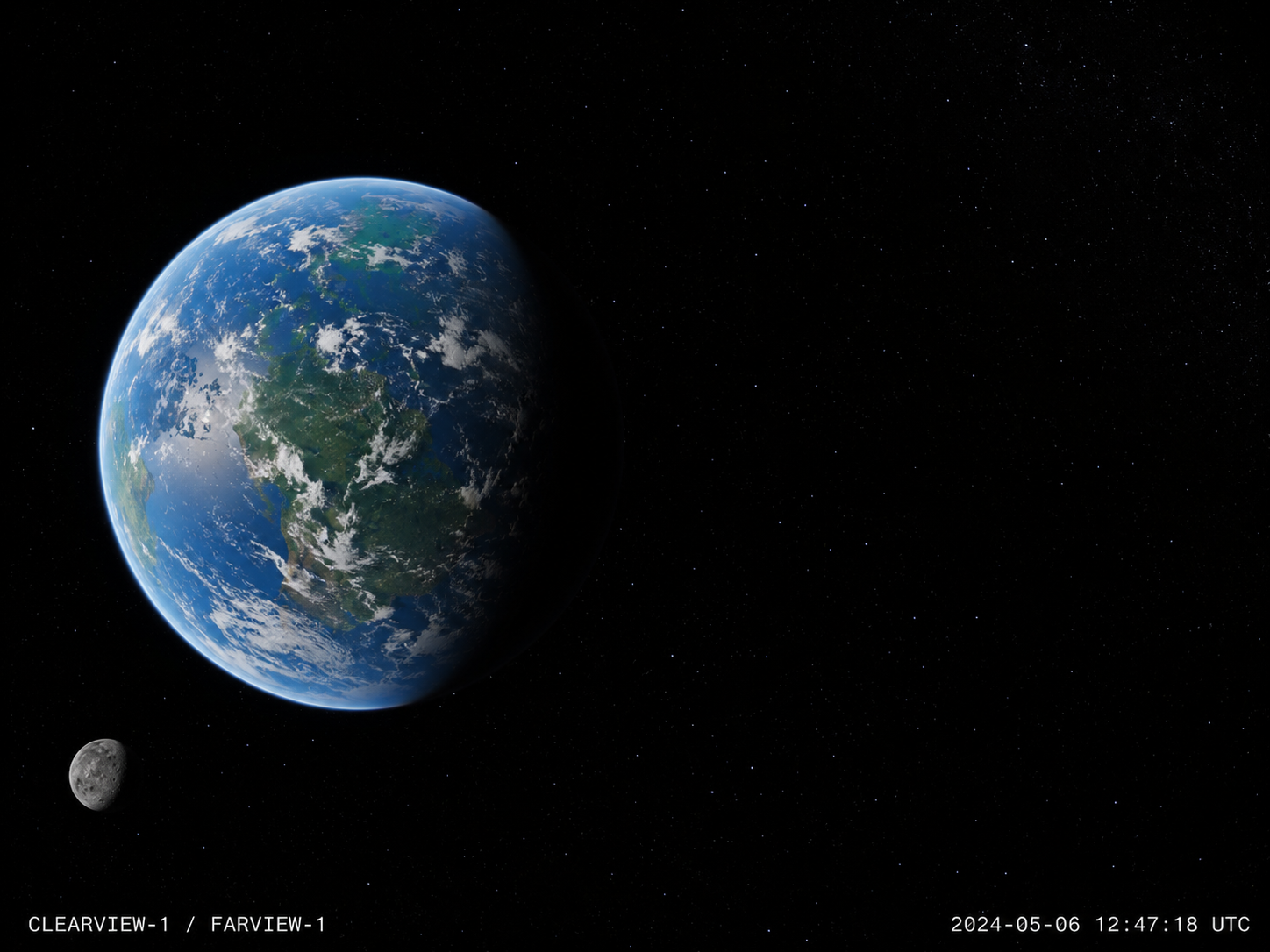
- "The Farewell Shot" - Kerbin and the Mun from departing trajectory; the most-shared image in MSC history (4.1M shares within 48 hours). Transmitted four hours after Mun gravity assist completion.
- Mun flyby - Close-up of the Mun's near-side surface during gravity assist. Resolution assessed by OMQ as comparable to purpose-built planetary probes.
- First solar orbit deep-field - Wide-field acquisition image after solar insertion. Contains an anomalous point source at upper-right not corresponding to any catalogued object. Direction is consistent with the inferred position of UO-001, now understood to be the Juno anomaly.
Observation targets
At least two of FARVIEW-1's planned primary observation targets are in the direction of the point source identified in its first deep-field image, now understood to be the Juno anomaly. KeedMartin has not published a target list. NASA has not commented on the target list. The probe is maneuvering.
SOLARCOM
FARVIEW-1 was the first MSC asset to use SOLARCOM operationally. The SOLARCOM relay network is now confirmed as the primary communications architecture for all MSC assets beyond Kerbin's local neighbourhood, including FARVIEW-1 in solar orbit and HESTIA in transit to Duna.
FSOMFSOMarticle
The FSOM (Final Stage Orbital Maneuver Engine) is a propulsion module manufactured by KeedMartin that attaches between payload and the third stage of a KOEING SLS2 rocket. It provides a high-impulse burn capability beyond what the SLS2 direct-injection profile can achieve - enabling precise orbital or trans-system insertions that would otherwise require an oversized launch vehicle.
FSOM has completed multiple operational flights, all using KOEING SLS2 stacks. All succeeded. No press releases have been issued after any flight.
Operational missions
- FSOM-1 (POTHOLE delivery) - Delivered KFD's POTHOLE telescope module to LSI 1.
- FSOM-2 (FARVIEW-1) - Delivered FARVIEW-1 on trans-Mun injection and provided the primary burn for solar orbit insertion.
- FSOM-3+ (LSI 2 module delivery) - Delivered expansion modules to LSI 2.
The FSOM is not marketed as a standalone product. KeedMartin describes it as an "integrated mission architecture component." OMQ has described it as "a very good upper stage with a confusing name."
Gwenford KermanGwenford_Kermanarticle
Gwenford Kerman (she/her) is a kerbal medical officer, currently aboard HESTIA en route to Duna. She is one of the HESTIA Eight, responsible for the health of all eight crew members during transit and at Duna.
She has confirmed medical status in daily check-ins with MSC ground control using the same wording each time: "Medical status of all eight crew: nominal." The consistency is considered reassuring. She has not varied the wording, the tone, or the cadence. KerbTab has called this "the most reliable thing in the entire space program, including the R-SLS2."
She has also confirmed the status of the fern, which is aboard HESTIA and is widely believed to belong to Valentina Kerman. The fern's status is: nominal.
HESTIAHESTIAarticle
HESTIA is the first interplanetary vehicle of the MSC program, currently en route to Duna with a crew of eight. The ship was assembled in Kerbin orbit from modules delivered by KerbalX and KeedMartin, with propulsion integration by KOEING. It is the largest single vehicle ever built by kerbalkind.
HESTIA departed Kerbin orbit in Year 419 following a trans-Duna injection burn. Commander Valentina Kerman confirmed departure with two words on Crewgram: "She is away." The post received 18.7 million likes, the all-time Crewgram record.
Design and redundancy
HESTIA was designed under a program-wide engineering culture that prioritizes redundancy above all other metrics. Every critical subsystem has at least three independent layers of backup. Huddin Kerman, the ship's engineer, conducted a full redundancy audit during integration and found four cases where subsystems had four redundancies and one case where a subsystem had five. The audit was published in full. OMQ described it as "the most reassuring document in MSC history."
Dosos Kerman, who transferred to HESTIA from the Confidence program, described the ship as: "Coming from Confidence, HESTIA feels like she was built by kerbals who were being paid extra to be worried."
Science complement
HESTIA carries the VESTA (Vector Spectroscopy and Terrain Analysis) module, operated by mission specialist Melody Kerman. VESTA is designed for remote compositional analysis of Duna's surface and atmosphere from orbit. The module was activated during transit for calibration. All channels are green.
Medical operations
Medical officer Gwenford Kerman (she/her) is responsible for the health of all eight crew during transit and at Duna. She has confirmed medical status in daily check-ins with the same wording each time: "Medical status of all eight crew: nominal." The consistency is considered reassuring. Kerbal indefinite viability means the mission is bounded by snack supply, not by lifespan.
Communications
HESTIA communicates through the SOLARCOM relay network. All transmissions pass through solar-orbit relay satellites to LSI 2 and then to MSC ground control. Wildock Kerman, aboard LSI 2, is the primary HESTIA relay operator. She confirmed the first SOLARCOM handshake with the transit crew: "Eight kerbals on the other end of the relay. They sound fine."
Transit life
The crew's transit routine is structured around maintenance cycles, science calibration, physical exercise, and meal rotations. Guillermo Kerman, the helmsman, described piloting HESTIA as: "Piloting HESTIA is like driving a very expensive bus." Katdorf Kerman, the scientist, has been observing Duna through the ship's instruments as it grows larger in the viewport: "Every day a little more red in the cupola. We are coming."
The other mission
HESTIA's science complement includes equipment consistent with remote observation of the Juno anomaly, in addition to its Duna mission objectives. NASA has not confirmed this. OMQ has published the instrument specifications. The specifications are consistent. Administrator Clane has not taken a vacation.
HESTIA EightHESTIA_Eightarticle
The HESTIA Eight are the eight kerbals currently aboard HESTIA, en route to Duna. They are the first crew to leave Kerbin's immediate neighbourhood. The crew composition was announced in Year 418 following a selection process that NASA described as "lengthy, careful, and occasionally loud."
| Role | Kerbal | Note |
|---|---|---|
| Commander | Valentina Kerman | First in orbit, first EVA, first on the Mun. Now first to Duna. |
| Helmsman | Guillermo Kerman | "Piloting HESTIA is like driving a very expensive bus." |
| Engineer | Huddin Kerman | Conducted the redundancy audit. Found four cases of four. Found one case of five. |
| Mission Specialist (VESTA) | Melody Kerman | Operates the VESTA science module. First activation during transit. |
| Medical Officer | Gwenford Kerman (she/her) | Daily check-ins: "Medical status of all eight crew: nominal." Always nominal. |
| Scientist | Katdorf Kerman | First detected the Juno anomaly from LSI 1. Now going to Duna. "Every day a little more red." |
| Crew | Samsey Kerman | "The light comes through the viewport at a different angle every cycle because we are not in Kerbin orbit anymore." |
| Engineer | Dosos Kerman | Transferred from Confidence. "HESTIA feels like she was built by kerbals who were being paid extra to be worried." |
KerbTab published an official crew bracket shortly after departure. It received 9.1 million likes. The caption read: "They are going to Duna. We are not. We are coping."
Huddin KermanHuddin_Kermanarticle
Huddin Kerman is a kerbal flight engineer, currently aboard HESTIA en route to Duna. She was the first kerbal to board LSI 1, performing the systems checkout following MSC-003's docking. She performed the MSC programme's second extravehicular activity, deploying RESTLESS's solar arrays as part of the module's integration sequence.
During HESTIA integration, she conducted the full redundancy audit that became the defining document of the ship's engineering culture. Her finding - that some subsystems had four redundancies and one had five - was published in full. OMQ described the audit as "the most reassuring document in MSC history."
Her Crewgram post from the audit - "Every subsystem on this ship has three redundancies. I have found four cases of things that have four redundancies. I have found one case of five." - received 2.4 million likes. She is also the subject of Redundancy, Ammie Voss's documentary about HESTIA's engineering culture. She has not seen the film. She was asked about it. She said: "I was there. I do not need to see it." This is, by one count, the second time a kerbal has used this exact phrase about an MSC film. The first was Valentina Kerman about First Dust.
Jedidiah KermanJedidiah_Kermanarticle
Jedidiah Kerman is a kerbal pilot. He flew MSC-003 as commander aboard R-SLS2, conducted the first successful docking in MSC history, and later returned to Kerbin alone - undocking from LSI 1 following RESTLESS integration and completing a solo reentry described by NASA as nominal. He subsequently flew MunShot Phase 1 orbital missions.
His solo return via R-SLS2 remains the only instance of a single kerbal operating an R-SLS2 capsule from undocking through landing. NASA rated it nominal. KerbTab has rated it "extremely chill actually."
Juno anomalyJuno_Anomalyarticle
The Juno anomaly, internally designated JN-001, is an anomalous spacetime feature first detected in Year 414 by Katdorf Kerman using the POTHOLE telescope aboard LSI 1. It was first publicly referred to in Year 415, when OMQ published a letter noting that the telescope's pointing pattern over multiple passes was consistent with a body or feature that did not correspond to any catalogued object.
Katdorf's Crewgram post from Year 414 - "day 49. I have seen something." - is, in retrospect, the first public detection of the anomaly. The post received 620,000 likes. She did not post again for six months.
OMQ's independent analysis, published in Year 416, concluded that the observational data was consistent with wormhole topology - a region of spacetime connecting two distant points via a non-trivial geometry. NASA has subsequently declined, on nine separate occasions, to use the word "wormhole." The official phrase is "anomalous spacetime feature." The phrasing has been remarkably consistent, in the same way the UO-001 non-denials were consistent: "We are investigating. What we are investigating - that conversation is for another day."[3]
What is publicly known
- Something was observed by Katdorf Kerman from LSI 1's POTHOLE telescope, beginning Year 414.
- That something is in the Jovian region of the outer system.
- OMQ's topology analysis (Y. 416) concluded the observational data is consistent with wormhole geometry, not with a conventional body.
- The SOLARCOM relay network geometry is consistent with a communications relay for the anomaly.
- The HESTIA transit trajectory to Duna does not pass through the Jovian region, but HESTIA's science instrument complement includes equipment consistent with remote observation of the anomaly.
- NASA has not said "wormhole." OMQ has said "wormhole." The Kerbin Herald has said "wormhole." KerbTab has said "WORMHOLE" in all caps. The Roads Party has said it is "a distraction from road paving."
Relationship to UO-001
The Juno anomaly is believed to be the same phenomenon previously catalogued as UO-001, the "Unknown Object" first inferred from SOLARCOM relay geometry and FARVIEW-1 deep-field imaging in the Era 3 timeframe. UO-001 was never publicly identified. The Juno detection, from a different instrument at a different time, produced data consistent with the same location. OMQ has published a correlation analysis. NASA has acknowledged the analysis. The acknowledgement was the only part of the response that contained information.
Why nobody has said it out loud (update)
As of Year 419, the situation has evolved. The anomaly is publicly known. The topology is publicly known. The word "wormhole" is in common usage. What NASA has not done is: confirm it officially, specify what is on the other side, specify whether it is stable, or specify what HESTIA's science instruments are looking for beyond Duna.
The Kerbin Herald beat reporter's current assessment: "They know what it is. They have known what it is for years. They are building a programme around it. The HESTIA mission is part of that programme. Duna is the public mission. The other mission is the one they have not announced. We are waiting for the announcement. We expect to keep waiting."
See also
SOLARCOM · NASA · FARVIEW-1 · HESTIA · Wernhardt Clane · Kerbol System · Orbital Mechanics Quarterly · Katdorf Kerman · UO-001References
- OMQ letter, Y. 415. "On the pointing pattern of the POTHOLE telescope, LSI 1."
- OMQ Y. 416. "Topology analysis of JN-001: wormhole geometry consistent with observational data."
- Press conference transcripts, NASA, Y. 415-419. Non-denials, identically phrased.
- The Kerbin Herald editorial, Y. 417. "On the word NASA will not say."
Katdorf KermanKatdorf_Kermanarticle
Katdorf Kerman is a kerbal scientist, currently aboard HESTIA en route to Duna. She flew MSC-003 and activated the LSI 1 science module within hours of boarding, conducting the first active scientific operations of the MSC station program.
She is the kerbal who first detected the Juno anomaly, using the POTHOLE telescope aboard LSI 1 to observe deep-space coordinates that did not correspond to any catalogued object. Her Crewgram post on mission day 49 - "I have seen something." - is, in retrospect, the first public detection of what OMQ would later confirm as a wormhole. The post received 620,000 likes. She did not post again for six months.
She is now one of the HESTIA Eight, serving as the mission's primary scientist. Her most recent Crewgram post from transit: "Duna is getting bigger. Every day a little more red in the cupola. We are coming."
KeedMartinKeedMartinarticle
KeedMartin is the smallest of the three major MSC contractors. It is best known for the VAJE air-augmenting jet engine, the RESTLESS and OBSERVE modules on LSI 1, multiple modules on LSI 2, the POTHOLE telescope, FARVIEW-1, and the HESTIA science complement including the VESTA module.
KeedMartin designed, built, and operates FARVIEW-1, the MSC program's first deep-space probe, now in solar orbit. The probe's CLEARVIEW-1 camera system, a derivation of the POTHOLE telescope, produced the "Farewell Shot" and the deep-field image that first hinted at the UO-001 / Juno anomaly.
For HESTIA, KeedMartin delivered the VESTA (Vector Spectroscopy and Terrain Analysis) science module, the greenhouse/agriculture module now operational on the Mun base, and several of LSI 2's expansion modules. KeedMartin's FSOM upper stage has flown operationally multiple times and is the standard upper stage for precise orbital insertion missions.
KeedMartin's marketing materials continue to advertise VAJE payload gains that exceed independently-measured figures by approximately 4 percentage points. OMQ has corrected the numbers in print three times. KeedMartin has not updated its brochures. They have, however, updated the brochure cover to show the HESTIA departure image.
Kerbal biologyKerbal_Biologyarticle
The kerbal (Kerbalis sapiens) is a small, four-limbed, predominantly green sapient species native to Kerbin. Adults stand approximately seventy-five centimetres tall, mass approximately forty-two kilograms, and exhibit a number of biological features that have been described, by visiting linguists, as "surprising on first contact and increasingly surprising thereafter."[2]
The most widely-discussed feature of kerbal biology is that kerbals do not die of natural causes. They are, in formal medical terminology, indefinitely viable. A kerbal's organ systems do not appear to senesce on any measurable timescale; cellular telomeres regenerate; bones do not lose density; the cognitive substrate remains functionally identical from age four to age four hundred. Kerbals do, however, die - readily - from a small set of recognized causes, all of which involve mechanical trauma, vacuum, fire, or the absence of snacks.
Anatomy
Kerbals are bipedal with two arms, two legs, and one head, in standard configuration. The head is disproportionately large relative to the trunk and contains, by mass, more brain than skeletal material. The eyes are unusually wide, fixed forward, and capable of independent dilation, which gives kerbal expressions their characteristic earnestness even in routine situations such as filing taxes.
The greenness
Kerbal skin is green. The pigment responsible, kerbalin, is a chlorophyll-like compound that performs limited photosynthesis in surface skin layers - enough, on a sunny day, to offset roughly four percent of a resting kerbal's caloric needs.[3] Kerbal nutrition is therefore overwhelmingly heterotrophic. Kerbals do not, despite a popular misconception, "live on sunlight." They live on snacks and small amounts of sunlight, in approximately a 96:4 ratio.
Brown kerbals (K. s. brunneus) are a rare northern subspecies whose skin contains a different photosynthetic compound and who, on average, eat slightly fewer snacks. They constitute approximately 0.6% of the population. The most famous brown kerbal in modern history is Geneva Kerman, who has held three Council seats and one fishing record.
Indefinite viability
Kerbals do not die of natural causes. This is not a euphemism. It is not a hopeful approximation. It is the most thoroughly catalogued fact in kerbal medicine, and it has held without exception for the entire recorded history of the species.
Mechanism (proposed)
The mechanism is not understood. The leading hypothesis, proposed by Linus Kerman in Year 402, is that kerbal cells maintain a "continuously corrected" genome - that errors accumulate at the same rate they do in any other organism, but that an unidentified subcellular mechanism patches them at approximately the same rate. Linus described this as "a small, polite copy editor inside every cell."
Linus has been working on the problem for thirty-eight years. Linus is sixty-one. He has stated, in print, that he expects to solve it.[4]
Cultural consequences
The cultural consequences of indefinite viability are extensive and are discussed at length under demographics, funerary practices, and causes of death. In summary:
- Kerbals do not have a concept of "passing away peacefully." Death, when it occurs, is always an event. There is, accordingly, no kerbali word that maps cleanly onto the common-tongue word "peaceful" in this context.
- Funerals, when held, focus on the cause of death, the engineering response to it, and the question of whether the deceased had filed their volunteer form.
- Kerbals do not retire. They become consultants. The oldest known kerbal is generally agreed to be Old Bill, who has consulted on every Kerbin Council session since the Graeber administration and is widely believed to be approximately five hundred and forty years old.
- Insurance markets do not offer "life insurance" to kerbals. They offer "event insurance," which pays out only on a recognized cause and which has the highest fraud rate of any product in the kerbali financial system.[5]
Snack metabolism
Kerbals derive approximately 96% of their caloric requirements from snacks, which is the formal taxonomic category for the eleven foodstuffs the kerbal digestive system is rated to process. The remaining 4% is photosynthetic. Kerbals can, in principle, survive on sunlight alone for between four and nine standard days, after which they enter a condition known as snack famine and exhibit symptoms ranging from irritability to mortality.
Sleep, helmets, and the cone reflex
Kerbals sleep in two non-consecutive shifts of approximately ninety minutes each per six-hour day. During sleep they exhibit the cone reflex, an involuntary contraction of the orbital ridge that causes the eyes to point sharply upward and inward. This is the reason kerbal helmets feature an internal cone-relief geometry: a standard EVA helmet without cone clearance is, mid-sleep, a small medical emergency.
Implications for long-duration spaceflight
Kerbal indefinite viability has proven to be the enabling condition for the MSC program's most ambitious missions. Because kerbals do not age, long-duration missions are bounded by snack supply, volunteer fatigue, and vehicle integrity - not by biological lifespan. The HESTIA Duna transit, currently underway, is the longest crewed mission in kerbal history. The crew's medical status is nominal. Their snack reserve is at 94 percent. Gwenford Kerman, the medical officer, has confirmed this in daily check-ins. She has not varied the wording. This is considered reassuring.
See also
Causes of death · Snacks · Demographics of Kerbin · Kerbal medicine · Volunteer form · Funerary practices · HESTIAReferences
- Greene, J.K. Atlas of Kerbal Subspecies. KSC University Press, Y. 396.
- Voss, A. Field Notes on Kerbalkind. Independent press, Y. 408. Foreword.
- Kerman, L. The Indefinite Patient: kerbalin and the photosynthetic floor. KSC University Press, Y. 402. Ch. 2.
- Orbital Mechanics Quarterly guest editorial, Y. 410. "Linus expects to solve it."
- Kerbin Insurance Authority, Annual Fraud Report, Y. 418. Table 7.
KerbalXKerbalXarticle
KerbalX is one of three major MSC launch contractors. It builds the Starship family, including Starship Heavy 3 (which delivered SOLARCOM) and Starship Heavy 4 (which launched LSI 1 and LSI 2). It is the prime contractor for the LSI station program and the structural contractor for HESTIA.
KerbalX's early record was mixed. The company built and launched the Basic Station, whose docking port was found to be off-spec during MSC-002, leading to the station's decommissioning. The replacement, LSI 1, operated without incident through Year 417. LSI 2 has been fully operational since Year 418.
KerbalX has since flown LAS-compliant crewed vehicles for MunShot Phase 2 crew rotations. The SSTO program setback of Era 7 was a KerbalX project; the test vehicle returned intact but did not reach orbit. OMQ published the thermal model corrections. The thermal model was optimistic.
SH-4 remains the most technically complex vehicle in the program - methane/LOX, VAJE air-augmentation, and a 360 degree xenon ion stage - and is also the only vehicle currently certified to deliver pressurized station modules. HESTIA's primary structure was delivered by KerbalX Starship Heavy flights to Kerbin orbit for assembly.
KerbinKerbinarticle
Kerbin is the third planet from Kerbol and the only known body in the Kerbol system to support a four-limbed, generally green civilization with a postal service. It is small (mean radius 600 km), wet (about seventy percent ocean), and surprisingly fast (one rotation every six hours). It has two natural satellites - the Mun, which is large and grey and the subject of approximately ten thousand songs, and Minmus, which is small and mint-coloured and not.
Kerbin is the home planet of kerbals, who have, as of Year 419, sent thirty-eight of their number into orbit or beyond and lost none of them. The orbital effort is centrally coordinated by Melody Space Center on behalf of the planet's nominally elected government, the Kerbin Council. Kerbals have walked on the Mun. Kerbals are en route to Duna. The programme has not lost a single crew member.
Etymology
The name Kerbin is from the proto-Kerbali root kerb-, meaning "green thing that is alive," and the locative suffix -in, meaning "place where there are several." It is therefore approximately translatable as place of the several green things who are alive. This is widely considered accurate.[3]
The six-hour day
One full rotation of Kerbin takes six standard hours. It is universally agreed that this is not enough hours, and accordingly the Kerbin Council has, on three separate occasions, formally requested the planet rotate more slowly. These requests have been ignored.
The cultural consequences are substantial. Kerbals sleep in two non-consecutive shifts, eat between four and seven meals per cycle, and have a working vocabulary for "morning" that includes nine separate words[4]. The phrase "I'll do it tomorrow" means, on Kerbin, between three and eleven hours from now, depending on context.
Inhabitants
Kerbin is home to approximately 9.4 billion kerbals, with smaller populations of doots (a kind of large, polite herbivore), snack trees, and one (1) large aquatic mammal who has been observed in the Dricken Bay since pre-history and who, when asked, has not provided a name.
Kerbals notably do not die of natural causes. The implications of this for population modeling are substantial and are discussed at length under demographics.
Spaceflight
Kerbin's Melody Space Center (MSC), the planet's primary orbital launch facility, has been operational since the early proving era. Thirty-eight kerbals have reached orbit or beyond; none have been lost. The programme has progressed through nine eras: from initial orbital flights (MSC-001) through the LSI 1 station, the Mun landings, the Juno wormhole discovery, the LSI 2 station and Mun base, to the current HESTIA interplanetary vehicle en route to Duna.
References
- Lothric, B. Kerbin: An Affectionate Geography, 6th ed. KSC University Press, Y. 416. p. 12.
- Orbital Mechanics Quarterly, Y. 414, "Atmospheric notes from low orbit." Footnote 7.
- Greene, J.K. An Etymological Dictionary of Kerbali. Council Press, Y. 380.
- Linguistic Society of Kerbin Annual, Y. 405. "Counting mornings: a structural analysis."
Kerbol SystemKerbol_Systemarticle
The Kerbol System is the planetary system to which Kerbin belongs. It contains one star (Kerbol), seven planets, two natural satellites of immediate interest, several smaller bodies, and one (1) anomalous spacetime feature whose existence was first inferred from telescope data and confirmed by independent OMQ analysis as consistent with wormhole topology.
Bodies, in order
| Body | Type | Note |
|---|---|---|
| Moho | Innermost planet | Hot, fast, has a temper. Featured in three poems. |
| Eve | Inner planet | Purple. Atmosphere too thick to land twice. |
| Kerbin | Home planet | The good one. Wet, fast-rotating, full of kerbals. |
| Mun | Kerbin moon | Polite. Always watching. Walked on. Base operational. |
| Minmus | Kerbin moon | Mint-coloured. Sweet but unreliable. |
| Duna | Outer planet | Red. The aspirational one. HESTIA is en route. |
| Dres | Asteroid-class | Disputed planethood. Has a small fan club. |
| Jool | Gas giant | Green and large. Has five moons. Vibes uncertain. |
| Eeloo | Outer dwarf | Cold. Quiet. Speaks when spoken to. |
| Juno anomaly | Spacetime feature | See main article. Wormhole topology, OMQ-confirmed. NASA has not said the word. |
Crewed visitation history
- Kerbin orbit. 38 kerbals. 0 lost. Two stations operational (LSI 1, LSI 2).
- The Mun. 6 crewed landings. Base operational. 0 lost.
- Duna. HESTIA en route, 8 crew. 0 lost.
- Everywhere else. 0 crewed visits. Probes: FARVIEW-1 (solar orbit), CLEARVIEW-1 imaging active.
The SOLARCOM network of solar-orbit relay satellites is the communications infrastructure that connects all MSC assets beyond Kerbin's local neighbourhood. It is now confirmed as the relay architecture for FARVIEW-1 in solar orbit and for HESTIA in transit to Duna. Its geometry is also consistent with a relay for communications with the Juno anomaly. NASA has not said this. OMQ has said this.
KOEINGKOEINGarticle
KOEING is one of three major MSC launch contractors. It builds the SLS 2, SLS 3C, and R-SLS2 vehicles. Following the program-wide adoption of the Launch Abort System (a KOEING design), KOEING held the program's only abort-equipped, multi-mission crew vehicle through the early eras.
KOEING's standing in the MSC program is at a historic high. R-SLS2 flew MSC-002 and MSC-003 with a 2/2 success record. KOEING won the MunShot Phase 1 and Phase 2 contracts; R-SLS2 heritage vehicles delivered all six Mun landing crews safely. The company is also responsible for the propulsion integration on HESTIA.
Its public engineering philosophy - "don't reinvent what works" - has aged considerably better than that of some competitors during the same period. KOEING has not, as of writing, published thermal margin data for the R-SLS2 reentry envelope. OMQ is still waiting. OMQ has been waiting for eight years. OMQ expects to continue waiting.
Launch Abort SystemLaunch_Abort_Systemarticle
The Launch Abort System (LAS) is a tower-mounted solid-rocket assembly capable of pulling the crew capsule away from a vehicle stack during in-atmosphere emergencies. The first MSC vehicle to fly the system was R-SLS2, designed and built by KOEING.
Following the successful demonstration on MSC-002, NASA mandated the LAS spec as the program-wide safety standard for all crewed vehicles operating within Kerbin's atmosphere. All future MSC crewed vehicles, including all MunShot and HESTIA crew delivery vehicles, must meet or exceed the standard.
The mandate is widely considered KOEING's most consequential program contribution to date. KerbalX has since flown LAS-compliant crewed vehicles for MunShot Phase 2 crew rotations. The standard is non-negotiable per Administrator Clane's Y. 411 directive, reaffirmed in Y. 416 for all interplanetary crew delivery.
LSI 1LSI_1article
LSI 1 was the first crewed orbital station of the MSC program. It was launched aboard Starship Heavy 4 with the command module and science module pre-attached, following the decommissioning of the Basic Station. The station was crewed from Year 411 through Year 417, during which it was substantially expanded to six docked modules.
In Year 417, the final crew transferred to LSI 2, and LSI 1 entered uncrewed standby. It remains in orbit and is available as an emergency return node. The POTHOLE telescope module remains active under remote operation from LSI 2, continuing the astronomical observations begun by Katdorf Kerman during the crewed era.
Historical configuration
LSI 1 launched with two modules (command, science) and received four additions: an electrical module, the RESTLESS habitation module (KeedMartin), the OBSERVE observation cupola (KeedMartin), and the POTHOLE telescope module (KFD/KeedMartin). All four docking ports were occupied.
Notable events
LSI 1 was the site of the first successful MSC docking (MSC-003), the second EVA in MSC history (Huddin Kerman, deploying RESTLESS arrays), and the first detection of the Juno anomaly by Katdorf Kerman using the POTHOLE telescope. Katdorf's Crewgram post - "day 49. I have seen something." - is, in retrospect, the first public detection of the anomaly that would later be confirmed as a wormhole.
LSI 2LSI_2article
LSI 2 is the second crewed orbital station of the MSC program, launched as part of the expanded Large Station Initiative. It is the largest orbital station ever built by kerbalkind, with eight docked modules and all eight ports occupied. LSI 2 serves as the orbital hub for Mun operations, the Mun base relay, and as the primary communications relay for HESTIA during Duna transit.
Commanded by Madvis Kerman, the station carries a crew of eight: Madvis (CO), Dogun (Chief Engineer), Wilvan (Engineering/Life Support/Agriculture/Communications), Rafal (Engineering), Catwig (Science), Wildock (HESTIA relay/Science), FroFrod (Engineering), and Lovin (Science).
Madvis Kerman posted the first photograph of LSI 2 from the cupola: "Eight modules, eight ports, eight views. She is beautiful." The post received 3.2 million likes.
Configuration
LSI 2 launched with a core command module and science module, and has since been expanded with six additional modules: a power array, a habitation module, a greenhouse/agriculture module, a communications relay module, a docking hub, and an engineering workshop. All eight ports are occupied. Dogun Kerman confirmed the power grid activation: "All arrays deployed. All ports occupied. Zero spare fuses. As intended."
Mun base relay
LSI 2 serves as the primary communications relay between the Mun base and MSC ground control. The relay module, operated by Wildock Kerman, also handles HESTIA transit communications through the SOLARCOM network. Wildock confirmed the first HESTIA handshake: "Eight kerbals on the other end of the relay. They sound fine."
Life support and agriculture
The agriculture module, operated by Wilvan Kerman, provides supplemental snack production and atmospheric cycling. Wilvan posted: "Life support nominal. Snack reserve at 94 percent. Ag module cycling green. I grew a snack. On a station." The station's life support is rated for indefinite crewed operation with the agriculture module active.
Science operations
Science operations aboard LSI 2 are managed by Catwig Kerman and Lovin Kerman. Lovin Kerman posted: "HESTIA gets the headlines. We get the data. Both matter." The station's science complement includes materials processing, astronomical observation, and ongoing monitoring of the Juno anomaly region.
Relationship to LSI 1
LSI 1 remains in orbit and was crewed until Year 417, when the final crew transferred to LSI 2. LSI 1 is now in uncrewed standby, available as an emergency return node. Its POTHOLE telescope module remains active under remote operation from LSI 2.
Madvis KermanMadvis_Kermanarticle
Madvis Kerman is a kerbal scientist and commander, currently serving as commanding officer of LSI 2. She flew MSC-002 as science officer, during which the Basic Station docking failure was discovered. She was portrayed by Renn Okafor in the film Open Door. Madvis commented on the portrayal once: "They got my silence right too."
As CO of LSI 2, she oversees the largest orbital station in kerbal history, its crew of eight, and the relay operations connecting MSC ground control to both the Mun base and HESTIA in transit. Her Crewgram post from the cupola - "Eight modules, eight ports, eight views. She is beautiful." - received 3.2 million likes.
Main PageMain_Pagearticle
Featured article
In the news
- · HESTIA en route to Duna - eight crew, nominal status, SOLARCOM relay active. Commander Valentina's departure post at 18.7M likes and climbing.
- · Juno anomaly confirmed as wormhole topology by independent OMQ analysis. NASA has used the phrase "anomalous spacetime feature" in three press briefings. Nobody at NASA has said "wormhole" out loud.
- · LSI 2 fully operational - eight modules, eight crew, all ports occupied. Mun base greenhouse yields first harvest.
- · MunShot Phase 2 complete - six crewed Mun landings, zero crew lost. The Mun has been walked on. Murray Kerman was not available for comment.
- · SSTO program setback - test vehicle returned intact but did not reach orbit. OMQ published the thermal model corrections. The thermal model was optimistic.
Did you know...
- ... that kerbals do not die of natural causes, and consider this unremarkable?
- ... that the Kerbin Council Chamber roof has been "due for repair" for one hundred and fifty years?
- ... that HESTIA carries enough snacks for a Duna round trip with a 40 percent margin, and the engineer responsible called this "adequate"?
- ... that the Juno anomaly was first detected from a telescope module designed to photograph potholes?
- ... that Valentina Kerman has a total of seven Crewgram posts and 18.7 million followers, making her the least prolific and most followed kerbal on the platform?
On this date
- · The Greening is observed (annual; required).
- · Valentina Kerman reached orbit aboard SLS 3C. (12 years ago)
- · HESTIA departed Kerbin orbit for Duna. (this year)
- · First crewed Mun landing. MunShot Phase 2. (3 years ago)
- · The Pothole Question was first raised in Council. (95 years ago)
- · Kerbol rose. (today; routine)
From today's featured list
- · Lithobraking (informal term for terrain impact at unscheduled velocity)
- · Unplanned rapid combustion
- · Vacuum exposure (helmet-related)
- · Drowning (rare; requires conviction)
- · Snack famine (last documented case: pre-Greening)
- · Disagreement with the Mun (one case, disputed; see note on Mun landings)
- · Volunteer status (procedural; see entry)
Melody Space CenterMelody_Space_Centerarticle
Melody Space Center (MSC) is the planetary launch and mission-coordination facility of Kerbin. It is administered by NASA, contracted through KOEING, KerbalX, and KeedMartin, and is, by Council appropriation, "unlimited" in budget.
To date, MSC has placed 38 kerbals in orbit or beyond. None have been lost. Two orbital stations are operational: LSI 1 (uncrewed standby) and LSI 2 (fully crewed). A Mun base is operational on the Mun surface. HESTIA is en route to Duna with eight crew.
The most senior public figure at MSC is Administrator Wernhardt Clane, who has not, on the record, taken a vacation in twelve years. The reasons are discussed elsewhere.
Active programs include the LSI 2 station, the Mun base, HESTIA Duna transit, SOLARCOM deep-space relay, and the Juno anomaly investigation. KOEING completed MunShot Phase 1 and 2 with a clean R-SLS2 record; KerbalX delivered the HESTIA structure; KeedMartin delivered HESTIA's modules and the VESTA science instrument.
Melody Space Center / Mission patchesMelody_Space_Center/Mission_Patchesarticle
Each MSC mission and major program receives a mission patch, designed in-house by the MSC Insignia Office and stitched in a small workshop in KSC City by Mrs. Kerblin Kerman, who has done this work since the program began and who, when asked, has declined to retire on six separate occasions.
The canonical inventory below is the version flown. Variant patches — prototype, training, contractor-internal, and the unofficial "wrong door" patch reportedly circulating in KerbalX hallways — are out of scope for this subpage and are catalogued separately under variant insignia.

Designed Y. 407. Flown Y. 407. Commander: Valentina Kerman. The Insignia Office's last patch in the gold-and-navy "founding" livery before the move to all-black.

The three figures along the lower limb represent the crew of R-SLS2. The station, in retrospect, is depicted optimistically.

The flare at the docking interface is, per the design notes, "deliberately small." Mrs. Kerblin's stated reason: "we have had enough drama at this port."

The teal border distinguishes contractor-issued program patches from MSC mission patches. Worn by KerbalX integration staff during the launch campaign and now by approximately 4,000 KerbalX employees who were not on the launch campaign.

The boot print was added after the first landing. The original patch had no boot print, because the Insignia Office did not want to assume success. The first landing succeeded. The boot print was added. Mrs. Kerblin stitched it by hand. She said it was the only patch that made her nervous.

The three concentric rings represent the three-redundancy minimum. Huddin Kerman asked for four rings. The Insignia Office declined. The four-redundancy cases are represented by a fourth, thinner ring visible only under direct light. Huddin approved. Mrs. Kerblin stitched it in a single afternoon and said it was "the most layers I have ever put on a patch."
MSC-002MSC-002article
MSC-002 was the second crewed flight of the MSC program and the first to attempt an orbital docking. The mission was launched aboard R-SLS2 with three crew: commander Valentina Kerman, scientist Madvis Kerman, and engineer Dogun Kerman.
On approach to the Basic Station, the crew found the station's docking port could not accept R-SLS2's standard interface. Valentina Kerman performed an unplanned EVA - the first in MSC history - manually deploying a stuck solar panel and confirming the spec mismatch. The crew re-boarded and returned safely on a Mach 3+ reentry.
NASA's official statement classified the mission outcome as a "successful EVA demonstration with attached station program review." This phrasing has been the subject of considerable Talk-page argument as to whether MSC-002 was a failure (lost docking, station decommissioned, vehicle stack on standby for hours) or a success (no crew loss, EVA achieved, spec failure detected). The Kerbin First Daily ran with "failure." Crewgram ran with "hero." Both can be partially correct.
The MSC-002 reentry remains the highest-Mach number reentry attempted by R-SLS2; OMQ has formally requested KOEING publish thermal margin data and is still waiting.
MSC-003MSC-003article
MSC-003 was the third crewed mission of the MSC program and the first to successfully dock at an MSC station. R-SLS2 launched with three crew, rendezvoused with LSI 1, and docked according to flight plan. The mission has been completed.
Huddin Kerman was the first kerbal to board LSI 1, performing systems checkout. Katdorf Kerman activated the science module within hours of boarding. The mission script ran end-to-end without any of the unscheduled events that defined MSC-002.
Jedidiah Kerman returned to Kerbin solo via R-SLS2 following RESTLESS integration. Huddin and Katdorf remained aboard for an extended stay. The crew completed all MSC-003 objectives without unscheduled events. LSI 1 was subsequently crewed through Year 417, when operations transferred to LSI 2.
Mun baseMun_Basearticle
The Mun base is the first permanent surface installation on a body other than Kerbin. It was established following the completion of MunShot Phase 2, which achieved six crewed Mun landings between Year 416 and Year 418. The base consists of a habitat module, a greenhouse module, and a communications relay linking to LSI 2 in Kerbin orbit.
The base is crewed on a rotating basis, with three to four kerbals per cycle. The first crew included Catwig Kerman, who activated the greenhouse module and produced the first off-planet harvest in Year 418: a single greenwafer grown in Mun regolith amended with Kerbin soil stocks.
Greenhouse
The greenhouse module is the first facility to produce snacks on a body other than Kerbin. Catwig Kerman posted a Crewgram photograph of the first harvest: "They grew. On the Mun. In the dirt that is not dirt." The post received 4.1 million likes. The implications for interplanetary mission snack logistics are substantial: if snacks can be produced at a destination, the snack reserve requirement for return trips can be reduced, extending mission duration limits.
Science
The Mun base conducts surface science operations including regolith analysis, seismic monitoring, and astronomical observation from the Mun's atmosphere-less surface. The base's telescope, a derivative of the POTHOLE-CAM optical system, provides a stable observation platform for deep-space work.
MunShotMunShotarticle
MunShot was the MSC program to land kerbals on the Mun. Phase 1 (flyby and orbital) was completed by KOEING using R-SLS2 heritage vehicles. Phase 2 (crewed surface landing) achieved six successful Mun landings between Year 416 and Year 418.
The first Mun landing was commanded by Valentina Kerman, who became the first kerbal on the Mun surface. Her first words on the surface were: "Quiet, and grey, and not a hologram." The last two words were directed, posthumously, at Murray Kerman.
All six landings were completed without crew loss. Zero kerbals have been lost in the entire MSC program, through nine eras. A Mun base is now operational on the surface.
Phase 1
Phase 1 consisted of orbital and flyby missions to survey landing sites and validate navigation. KOEING won the Phase 1 contract on the strength of R-SLS2's 2/2 success record.
Phase 2
Phase 2 consisted of six crewed landings. The landing site was on the near side, within visual range of Kerbin's evening telescopes, on the explicit Council-stated grounds that "if we are going to do this we would like to be able to see them."
OBSERVEOBSERVEarticle
OBSERVE is an observation cupola and engineer utility station docked to LSI 1, manufactured by KeedMartin. It serves as a visual and EVA monitoring node and carries staged stores of spare solar panels, batteries, EVA repair kits, and jetpack reserves for station maintenance operations.
The additional habitation volume contributed by OBSERVE, combined with RESTLESS, gave LSI 1 a rated capacity of eight crew for extended stays, up from the original three-berth configuration.
Politics of KerbinPolitics_of_Kerbinarticle
Politics on Kerbin is governed by an institution called the Kerbin Council, which is, by design and by accident, indefinite. The Council has 412 seats. Seats are filled by election. Election occurs when, and only when, a sitting councillor either (a) resigns voluntarily, (b) dies via one of the seven recognized causes, or (c) is removed by a two-thirds vote of the other 411 councillors, which has happened, in the entire history of the Council, four times.
Several Council seats have therefore been held by the same kerbal for over four hundred years. The seat for the Dricken Valley district has been held continuously by Old Bill since the early Graeber administration. Old Bill is widely believed to be approximately 540 years old. Old Bill has not given a press conference since Year 380. Old Bill's office is staffed by a series of increasingly puzzled grandchildren.
The Council Indefinite
The Council is the planet's only legislative body. It was constituted in Year 188 with a fixed membership of 412 kerbals, one per geographic district. The original constitutional drafters, who were younger then, did not anticipate that any individual councillor would still be in office in Year 419. They were wrong about this.
As a consequence, the Council has, on average, the demographic profile of a small farming village that has spoken to no one new since the Graeber administration. New councillors - fresh seats opened by death or resignation - are referred to internally as "the children," regardless of age. The youngest currently sitting councillor is 91.
Major parties
Snack Coalition (181 seats)
The largest party. Pro-snack subsidies, pro-Mun, pro-status-quo, pro-existing-roof-on-the-Council-Chamber, and since the Mun landings, pro-Duna. Founded Year 240. Leader: Petra Halvorn (in office since Y. 312).
Engineering & Sky (114 seats)
Pro-space-program. Aligned with NASA's funding requests since the early proving era. Has the soft endorsement of Wernhardt Clane, who is technically nonpartisan and technically not allowed to endorse anyone. The HESTIA departure was, for this party, the culmination of a twelve-year funding campaign. They have not stopped smiling since.
The Greens-In-Practice (79 seats)
An environmentalist party. Distinct from "The Greens," which dissolved in Year 318 over a snack-related scandal. The current incarnation focuses on ocean health, snack-tree forestry, and a long-running effort to reclassify the Dricken Valley as a protected region. Coalition partner with the Snack Coalition on most votes. Recently proposed that Mun base greenhouse technology be adapted for Kerbin agriculture. The motion passed.
Roads Party (1 seat)
The Roads Party has held one seat in the Council since Year 271. The seat is presently held by Mervin Tomfry, the uncle of Herschel Tomfry of Kerbin First Daily. Mervin has, in his entire career, voted "yes" on three motions and "no" on every other motion. The three motions all concerned road paving. The party platform is, in its entirety:
- Pave the roads.
- Pave more roads.
- The space program is a distraction from road paving.
The Roads Party has a small but durable rural base, a single weekly newsletter (Asphalt Today, circulation 4,200), and a national share of approximately 0.4%. It has held its single seat through 19 consecutive elections, including three in which it was the only party that fielded a candidate in the relevant district.
The Pothole Question
See main article: Pothole Question.
The Pothole Question is the longest-running unresolved question in Kerbin politics. First raised in Council in Year 324 by then-councillor Tomek Tomfry (great-grandfather of Herschel and Mervin), the question is, in its modern form: "Why are the roads, in particular, like that." The Council has, in the 95 years since, passed 412 separate resolutions intended to address it. The road outside the Council Chamber has the same pothole it had in Year 324.
The Mun Question (resolved)
The Mun Question - whether the planetary government should fund a crewed Mun landing as a matter of priority - has been resolved. Six crewed Mun landings have been completed. A Mun base is operational. The Mun has been walked on. The Roads Party voted "no" on every appropriation. The Roads Party has been overruled on every appropriation.
The Duna Question (new)
The Duna Question is the active successor to the Mun Question: whether the planetary government should fund interplanetary missions to Duna and beyond. The Snack Coalition is pro-Duna. Engineering & Sky is pro-Duna and has been pro-Duna since before it was politically viable. The Roads Party considers the Duna Question a distraction from road paving. HESTIA is already in transit. The question, in practice, is no longer whether to go but how much it will cost to keep going.
Famous Council moments
- The Treaty of Big Hill (Y. 311). Concluded the Big Hill Dispute after 14 years of debate. Signed during a snack break that was supposed to last 20 minutes and lasted four days. The third stripe of the modern flag was added during this snack break, by accident, and never removed.
- The Roof Question (Y. 271, ongoing). The Council Chamber has had a leaking roof since Year 271. Repair has been formally scheduled, voted, funded, defunded, refunded, and rescheduled 41 times. The roof leaks. The Council meets under buckets. See main article.
- The Snack Famine of Y. 408 (Dricken Valley incident). Eight kerbals refused to eat a particular brand of snack on principle and were lost to snack famine. The Council voted to subsidize the brand they had refused. The deceased did not respond to the subsidy.
- The Mun Landing Vote (Y. 415). The Council voted 408-4 to appropriate funds for MunShot Phase 2. The Roads Party voted no. Three independents abstained, citing "budgetary concerns." The First Snack-Bearer said "yes." It was the thirty-first time she had spoken in public.
- The HESTIA Appropriation (Y. 417). The Council voted 409-3 to fund the HESTIA program. The Roads Party voted no. Two independents voted no on the grounds that the snack reserve margin was "insufficient." The margin was subsequently increased from 30 to 40 percent.
Foreign policy (with whom?)
Kerbin has no foreign relations. Kerbin has been on Kerbin the entire time. The phrase "foreign policy" is, in formal Council usage, reserved for the Council's relationship with the Mun, which was treated, in policy documents, as a "potential foreign actor pending further data." The Mun has since been visited. The policy documents have not been updated.
The Juno wormhole has introduced a new category: the first phenomenon in the Kerbol system that is not a planet, not a moon, and not a probe. The Council has not yet determined how to classify it. The Roads Party has stated that it is "a distraction from road paving." Administrator Clane has not taken a vacation.
See also
The Kerbin Council · Pothole Question · Roads Party · Old Bill · Geneva Kerman · Council Roof · HESTIA · Juno anomalyReferences
- Constitution of Kerbin, Y. 188, Article III §2 (definition of First Snack-Bearer).
- Quist, J. Inside the Council: 412 Seats, 540 Years. KSC University Press, Y. 405.
- The Kerbin Herald archive, Y. 408-419.
- Roads Party platform, current edition. Page 1 (and only page).
POTHOLEPOTHOLEarticle
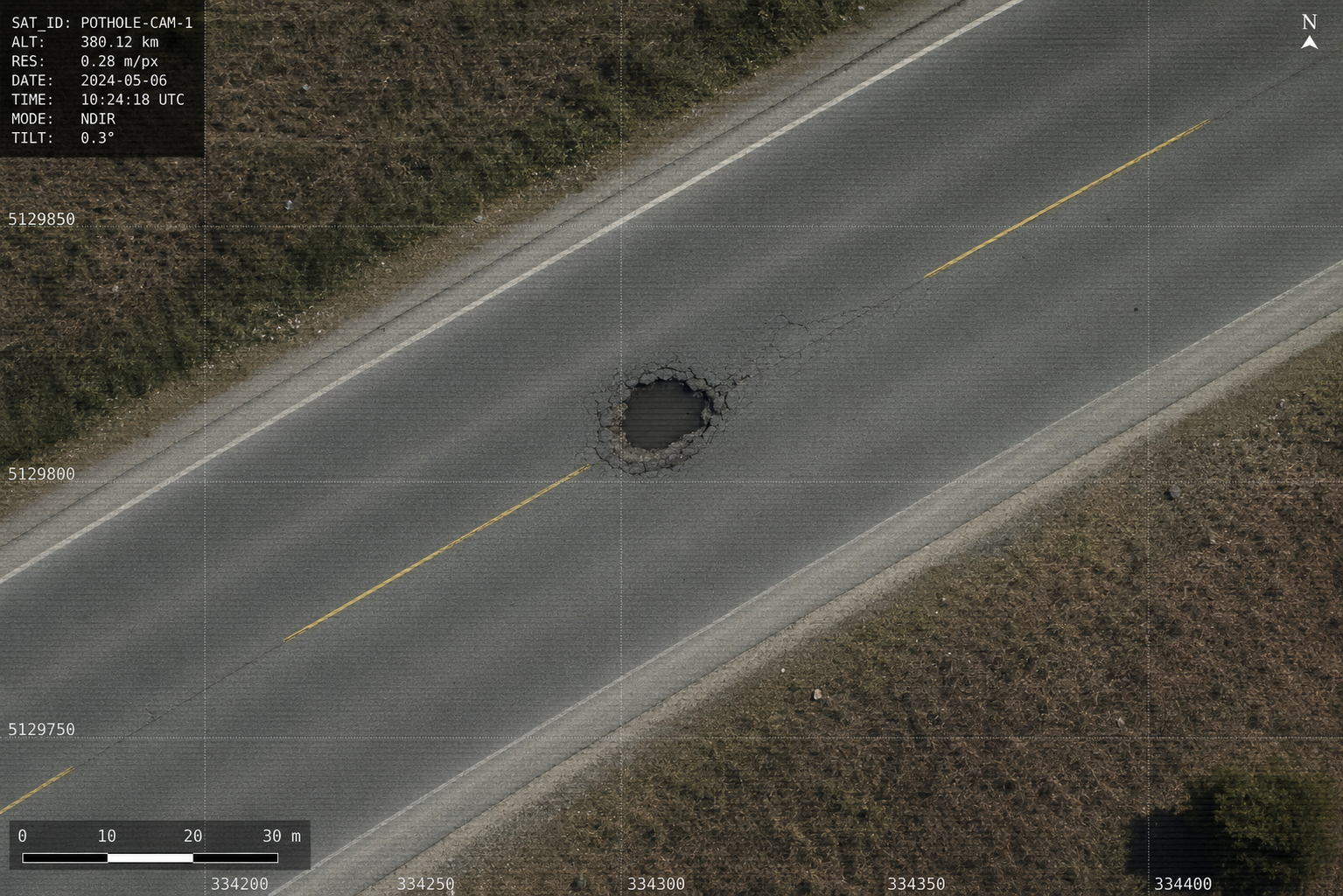
POTHOLE is the sixth and final module docked to LSI 1, owned and commissioned by Kerbin First Daily. It carries POTHOLE-CAM, a high-resolution downward-pointing telescope originally designed to photograph road infrastructure - specifically, the potholes of Kerbin - from orbit. It is the first civilian-owned module on a crewed MSC station.
Primary mission (KFD)
Kerbin First Daily commissioned POTHOLE with the explicit goal of photographing road potholes from orbit, as part of its three-hundred-year campaign on the Pothole Question. The module succeeded. KFD published the resulting images as front-page coverage. The Council was notified. The Council motion to repair the pothole was defeated 411-1.
Secondary mission (station crew, then remote)
The station crew repurposed POTHOLE-CAM for astronomical observation during orbital passes not over Kerbin ground targets. Huddin Kerman photographed the Mun's near-side surface on mission day 41. Katdorf Kerman subsequently directed the telescope at specific deep-space coordinates on multiple consecutive passes, detecting what would later be confirmed as the Juno anomaly.
Following the transfer of LSI 1's crew to LSI 2 in Year 417, POTHOLE-CAM continues to operate under remote control from LSI 2. It remains the only civilian-owned telescope in active astronomical service.
CLEARVIEW-1 heritage
The POTHOLE-CAM optical system shares a heritage lineage with FARVIEW-1's CLEARVIEW-1 instrument. Both were developed by KeedMartin from a common optics baseline. This was not publicly disclosed in either module's announced specifications. OMQ identified the optical family relationship from published aperture and resolution figures.
See also
LSI 1 · LSI 2 · Kerbin First Daily · FARVIEW-1 · FSOM · Pothole Question · Katdorf Kerman · Juno anomalyPothole QuestionPothole_Questionarticle
The Pothole Question is the longest-running unresolved political question in modern Kerbin politics. It was first raised in Council in Year 324 by Tomek Tomfry, the great-grandfather of Herschel Tomfry. The question, in modern form, is: "Why are the roads, in particular, like that."
The Council has passed 412 resolutions related to the Pothole Question. The road outside the Council Chamber has the same pothole it had in Year 324. The pothole has its own page on Kerbipedia. (See The Council Pothole.)
The Pothole Question is the foundational issue of the Roads Party, the Tomfry political dynasty, and the editorial identity of Kerbin First Daily. Herschel Tomfry mentions the Pothole Question, on average, in 92% of his published columns. (Source: word-frequency analysis, Kerbin Herald media desk, Y. 418.)
It is widely held, in KSC City, that the Pothole Question is not actually about potholes. It is, instead, the rhetorical container in which any frustration with the planetary government may be poured. "There is, again, a pothole," in modern usage, can mean any of: the budget is unfair, the roof is leaking, the space program is overfunded, or simply "I am tired."
R-SLS2R-SLS2article
R-SLS2 is a 3-kerbal crew variant of KOEING's SLS 2 launcher, currently the primary crew vehicle of the MSC program. It is the first MSC vehicle to fly with a tower-mounted Launch Abort System, which has since become a program-wide safety mandate.
R-SLS2 has flown two missions - MSC-002 and MSC-003 - with no anomalies attributable to the vehicle. KOEING's stated philosophy is that the vehicle exists to be "cheap, reliable, and unsurprising." Independent reviewers including OMQ have called it "the boring vehicle that keeps working," intended as a compliment.
The vehicle's clean record was the principal argument advanced for KOEING's successful MunShot bid. R-SLS2 heritage vehicles delivered all six MunShot Phase 2 crews safely.
RESTLESSRESTLESSarticle
RESTLESS is the habitation module of LSI 1, manufactured by KeedMartin and delivered by KerbalX's Starship Heavy 4B. It provides enlarged crew quarters, hitchhiker storage, a KerbalNet high-speed uplink, and a survey scanner for future integration with the station's science stack.
RESTLESS docks via an adapter that bridges legacy port geometry to the corrected docking standard established after the Basic Station incident. The original MSC-003 crew assisted the rendezvous and docking from the station side. Huddin Kerman performed an EVA to deploy RESTLESS's arrays, the second EVA in MSC programme history.
Roads PartyRoads_Partyarticle
The Roads Party is the smallest continuously-represented political party in Kerbin Council. It has held one seat since Year 271, currently Mervin Tomfry (Dricken Valley North).
Its platform, in full, is reproduced under Politics of Kerbin. The party has won every election in its district for 19 consecutive cycles, including three in which it was the only party that filed a candidate. Mervin has voted "yes" three times in his career, all on road-paving motions. He voted "no" on the Mun landing appropriation. He voted "no" on the HESTIA appropriation. He is expected to vote "no" on the next thing.
Snacks (foodstuff)Snacksarticle
Snacks is the formal taxonomic category for the eleven foodstuffs that the kerbal digestive system is rated to process. The category was canonized by the Kerbin Council in Year 240 and has not been revised since, despite seventeen separate proposals to add a twelfth.
Approximately 96% of a kerbal's caloric intake comes from snacks. The remainder is photosynthetic, via kerbalin. A kerbal deprived of snacks for more than approximately nine days enters snack famine, the only nutritional cause of death recognized by the Council.
The eleven canonical snacks
| № | Snack | Form | Note |
|---|---|---|---|
| 1 | Greenwafer | flat, crisp, mildly herbaceous | National emergency reserve. |
| 2 | Snack-cake (round) | spherical, dense, sweet | The original. Year 188. |
| 3 | Snack-cake (square) | cubic, dense, savoury | Council-controversial in Y. 311. |
| 4 | Drink-snack | thick liquid in a tube | EVA-rated. The astronaut's snack. |
| 5 | Mintsnack | small, green, brittle | Cultivated only on Minmus-pattern soil. |
| 6 | Long-snack | elongated, chewy | Lasts. Trail rations. |
| 7 | Quick-snack | tiny, fast, vanishing | Eaten 6 at a time. |
| 8 | Hot-snack | warm, breaded | Vendor-dominant. |
| 9 | Cold-snack | cold, custard-like | Northern subspecies preferred. |
| 10 | Real-snack | untranslatable | Disputed. Some say there are 10. |
| 11 | The eleventh snack | unspecified | The Council has, on three occasions, declined to specify what this is.[1] |
The identity of the eleventh canonical snack is the subject of a small but durable conspiracy literature. The most popular hypothesis is that the eleventh snack is "whichever snack the First Snack-Bearer is currently eating," a definition that is procedurally circular but operationally consistent.
Snacks in spaceflight
Snack supply is the primary duration-limiting factor for long-duration MSC missions. Because kerbals do not age, the constraint is not biological - it is logistical. The HESTIA Duna mission carries a snack reserve rated for a full round trip with a 40 percent margin. The margin was increased from 30 to 40 percent by Council amendment in Year 417 after two independents voted against the original appropriation on the grounds that 30 percent was "insufficient." The engineer responsible for the reserve calculation, Huddin Kerman, described 40 percent as "adequate." OMQ described this as "the most Huddin sentence ever uttered."
Snack Famine
See causes of death. Snack famine is the only mortality cause arising from kerbal physiology rather than mechanical event. Documented modern cases are rare. The most-cited modern incident is the Dricken Valley incident of Y. 408, in which eight kerbals refused to eat a particular brand of snack on principle.
Strategic snack reserve
The Kerbin Council maintains a 90-day strategic snack reserve, located primarily under the Council Chamber (which is, accordingly, structurally heavier than the original architects intended; this contributes to the famous Roof Question). The reserve has been drawn upon twice in modern history, both times during regional snack-tree die-offs.
Mun base greenhouse
The Mun base greenhouse module, operational since Year 418, is the first facility to produce snacks on a body other than Kerbin. The first harvest was a single greenwafer, grown in Mun regolith amended with Kerbin soil stocks. Catwig Kerman posted a photograph of it on Crewgram. The photograph received 4.1 million likes. The greenwafer was described by the base crew as "small, but real." This is the first documented case of a snack being produced off-planet. The implications for interplanetary mission snack logistics are substantial and are discussed at length in the HESTIA mission architecture documentation.
References
- Council Resolution №88 (Y. 240); §2 ("the eleventh snack shall not be specified").
- Kerbin Nutrition Board, Daily Snack Requirements, Y. 418.
- Mun Base greenhouse harvest report, Y. 418. "First off-planet snack production: greenwafer, single unit."
SOLARCOMSOLARCOMarticle
SOLARCOM is a network of solar-orbit relay satellites operated by NASA as the primary deep-space communications infrastructure for the MSC program. The network was built over four years, preceding any announced deep-space probe program. It is now confirmed as the communications architecture for FARVIEW-1 in solar orbit, HESTIA in transit to Duna, and - per OMQ's geometry analysis - potentially for communications with the Juno anomaly.
The network's relay positions, analyzed by OMQ in Year 410, are geometrically consistent with a solar-orbit relay architecture for a body in the direction of the anomalous point source first detected by FARVIEW-1. NASA has not confirmed this interpretation. NASA has not denied it. NASA has used the phrase "infrastructure for future mission requirements" in every public briefing on SOLARCOM since Year 408.
Wildock Kerman, aboard LSI 2, is the primary HESTIA relay operator. She confirmed the first SOLARCOM handshake with HESTIA during transit departure: "Eight kerbals on the other end of the relay. They sound fine."
The Kerbin CouncilThe_Councilarticle
The Kerbin Council is the legislative body of Kerbin. It has 412 seats, indefinite terms, and a leaking roof. It convenes year-round in KSC City, except during the Y. 311 snack break, which is technically still in progress.
The Council's most consequential ongoing work is, depending on whom one asks, (a) coordinating the MSC contract structure, (b) the Pothole Question, or (c) the matter of the roof. The Council has a permanent bucket budget. The bucket budget is funded.
For party composition, indefinite terms, and famous moments, see Politics of Kerbin.
The GreeningThe_Greeningarticle
The Greening is the annual public holiday observed on 1 Snackuary. It commemorates the date in Year 311 on which, by Council resolution, every kerbal alive at that moment was declared to be "counted, accounted for, and presumed to remain so." It is the only Kerbin holiday that has, by formal Council position, an attendance requirement.
The Greening is, in practice, a brief outdoor ceremony in which kerbals stand in direct sunlight for approximately one minute. The ceremony's stated purpose is to "engage the photosynthetic floor." Its actual function is roll-call. A kerbal who is not present at the Greening, in person, in their district of registration, is presumed to have moved, resigned from the species, or - in 0.0006% of annual cases - died of one of the seven recognized causes in the preceding twelve months.
The roll-call function exists because kerbals do not die of natural causes, and the planetary census is therefore, in principle, monotonically increasing. The Greening is the planet's primary correction mechanism. It is the only day of the year on which the Kerbin Council Statistician's Office is, technically, more important than the Council itself.
The MunThe_Munarticle
The Mun is the larger and closer of Kerbin's two natural satellites, the other being the smaller, mint-coloured Minmus. The Mun is approximately 200 km in radius, has a surface gravity of 1.63 m/s², and is widely agreed to be "right there."
The Mun has been the subject of approximately ten thousand songs, four hundred films, and - as of Year 416 - six crewed landings. The Mun has been walked on. A Mun base is operational. Murray Kerman was wrong.
Visibility
The Mun is visible from the surface of Kerbin during approximately 60% of any given six-hour day. Because Kerbin's day is so short, the Mun is observed to move noticeably across the sky during a single meal. Kerbal children commonly track its motion as a kind of clock. "The Mun is at the spire" is, in KSC City, an established way to say "approximately 4 PM."
Cultural significance
The Mun is the central body of kerbal folklore. It is variously described as a watching figure, a great grey friend, a benign relative, and (in a small minority of texts) "the one who is going to ask us where we have been." The dominant cultural framing, since at least the Graeber administration, is that the Mun is "polite."
Since the first crewed landing in Year 416, the cultural framing has shifted. The Mun is still polite, but it is also now a place kerbals have been. Valentina Kerman, the first kerbal on the surface, described the Mun as "quiet, and grey, and not a hologram." The last two words were directed, posthumously, at Murray Kerman.
This is in contrast to Minmus, which kerbal folklore describes as "sweet but unreliable."
The Mun follows you
It is widely observed by kerbal children, and reported in print as recently as Year 410, that the Mun appears to follow the observer when the observer walks. This has been formally investigated by the Kerbin Optics Society on three separate occasions, all of which concluded that the effect is a parallax illusion arising from the Mun's distance.
A six-month parliamentary inquiry, Y. 380, examined whether the Mun was actually following kerbals. The inquiry's final report concluded that "on present evidence, the Mun does not appear to be following kerbals deliberately, but the question is being kept open."[1] The question has remained open.
The Mun hologram hypothesis
See main article: Mun hologram hypothesis.
A small group of kerbals have, since Year 318, maintained that the Mun is not a physical object but a stable atmospheric projection. The most prominent advocate of the hypothesis was Murray Kerman, whose advocacy ultimately resulted in the addition of "disagreement with the Mun" as a recognized cause of death. The hypothesis has not been mainstream since. It is, as of Year 416, definitively incorrect. Six kerbals have stood on the Mun's surface. It is solid. It is grey. It is not a hologram.
The MunShot program
See main article: MunShot.
The MunShot program is the MSC contract that landed kerbals on the Mun. Phase 1 (flyby and orbital) was completed by KOEING. Phase 2 (crewed surface landing) was completed in six landings between Year 416 and Year 418. A Mun base is now operational, supporting ongoing surface science and greenhouse agriculture.
The Mun base
See main article: Mun base.
The Mun base is the first permanent surface installation on another body. It consists of a habitat module, a greenhouse module (which produced its first harvest in Year 418), and a communications relay to LSI 2. The base is crewed on a rotating basis. The greenhouse grew a snack. Catwig Kerman posted about it on Crewgram. The post received 4.1 million likes.
See also
MunShot · Mun base · Minmus · Songs about the Mun · Mun hologram hypothesis · Murray KermanReferences
- Council Inquiry into the Behaviour of the Mun, Final Report, Y. 380.
- Kerbin Optics Society, Parallax Studies on Bodies of Less Than 300 km Radius, Y. 365.
- Murray, T. The Mun is a Hologram and Other Errors, posthumous reprint, Y. 320.
- MunShot Phase 2 mission reports, Y. 416-418.
The Unknown ObjectThe_Unknown_Objectarticle
The Unknown Object, internally designated UO-001, was an astronomical body or artefact first detected by NASA in Year 405 and first publicly referred to in Year 408. It is now understood to be the same phenomenon as the Juno anomaly, confirmed by OMQ's topology analysis in Year 416 as consistent with wormhole geometry.
For the current understanding of this phenomenon, see Juno anomaly. This article is retained for historical context and for the record of NASA's non-denial pattern, which ran from Year 408 to Year 416 without substantial variation in wording.
Historical non-denial pattern
NASA declined, on six separate occasions between Year 408 and Year 412, to specify what the Object was. The phrasing of the official non-denial was: "We are building infrastructure. What we build it for - that conversation is for another day." The conversation occurred. OMQ had it without NASA.
FARVIEW-1 and the point source
FARVIEW-1's first solar orbit deep-field image contained a point source consistent with the inferred position of UO-001. The point source is now understood to be observational evidence of the Juno anomaly. The correlation was published by OMQ in Year 416.
Valentina KermanValentina_Kermanarticle
Valentina Kerman (born approximately Year 370) is a kerbal pilot, the first kerbal to reach orbit, the first kerbal to perform an extravehicular activity, and the first kerbal to walk on the Mun. She commanded MSC-002 aboard R-SLS2, during which she manually deployed a stuck solar panel on the Basic Station and discovered the airlock interface mismatch that ended that program. She later commanded the first MunShot Phase 2 landing, becoming the first kerbal on the Mun surface. She is currently the commander of HESTIA, en route to Duna.
She is the most-followed kerbal on Crewgram, with approximately 18.7 million followers and 7 total posts. Her departure post for HESTIA - "She is away." - received 18.7 million likes, the all-time Crewgram record, and is the most-liked post in the platform's history. She has not posted since.
When asked about the Mun landing film First Dust during a HESTIA transit check-in, she said: "I was there. I do not need to see it." KerbTab called this "the most Valentina response possible."
The houseplant question
Since Year 408, KerbTab has run, on average, one piece per quarter on the question of whether Valentina Kerman keeps houseplants. The current consensus is that there is, in the corner of the third photograph, possibly a fern. The fern now has 61,000 followers. It is aboard HESTIA. Gwenford Kerman has confirmed the fern is "nominal."